
 Posted by

Bajaj Finserv x Vaayu explore Design partnership, R&D-as-a-Service & custom Financial world model development
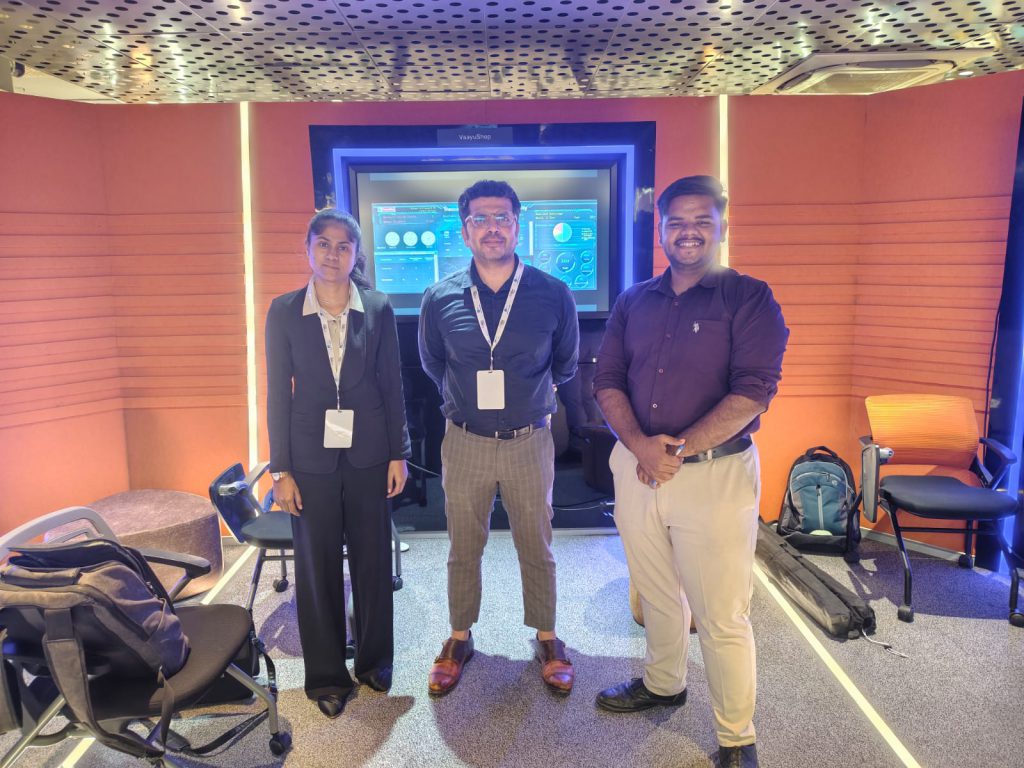
Vaayu recently presented its Financial World Model at Bajaj Finserv to their top management & business teams. Vaayu has been discussing Design partnership with companies building in-house proprietary Intelligence infra & platforms.
In this blog, we cover How Enterprise leadership can choose what they need in a Design or Implementation partner. We have spoken to many C-suite across industry, Founders, Fintech infra companies to banks
This is even suitable for a strategic investor, or even Fintech leadership going for strategic goals on AI adoptoin or building category leadership.
Mapping the entire market to AI Adoption & your company stage
We have been speaking to so many CEOs and top leaders on AI Intelligence. From top banks to small finance banks to fintech founders.
Each company is at a different stage. Each leader has a different temperament. Each board has a different mandate & mission. Certain CEOs are aiming to be category leaders. Certain others like Fintech infra companies, go pragmatic & want to do customer retention.
Even within a company, different teams may be at different stages.
It’s not about a race. It’s figuring out what stage your company is what’s the management’s goals.
- AI Adoption in progress but Business value trapped – The signs are that your organisation has implemented AI in some areas. Or built products. But now products are stuck, not going to produciton. Business use cases are there, but untrapping the business value is stuck. In this case – Go for Forward Deployed Engineers. You already have the systems ready. An external team comes & does system integration. Caveat – There are only 1200-4800 FDEs in India in AI. A lot many vendors are whitewashing every engineer as FDE.
- Vast scale, Digital adoption there, but systems & Databases are fragmented – In this case, go for Master Data Management, Data lakes & ontology based systems. Hire experts & set the core foundation. This not only untraps the hidden business value, it also gets your enterprise ready for AI/ML & GenAI adoptions.
- Alphas & Category Creators – Bajaj Finserv & a handful companies & leadership teams will create decisive leads. They not only create, use AI & own infra; they also build a design partnership ecosystem.
For many companies in the market, Business value is already there; AI systems are built, but business value is simply trapped. Because every company has some final pieces to come together to untrap this busines value to flow into their P&L.
Bajaj Finserv aims to be a category leader in AI & their numbers speak for themselves.
Our team sees that various banks and Fintech companies are at different stages in the Intelligence Infra layers.
So, we talked to all these companies to start with our R&D-as-a-Service & Forward-Deployed-Engineering team.
For more advanced-stage companies like Bajaj Finserv, talks go to a design partnership for long-term alpha.
Category Leadership in Finance & Vaayu Design partnership
World Models are gaining attention in Physical AI, where they help machines understand and simulate the physical world. At Vaayu, we are exploring how this concept can be brought into Enterprise AI — helping banks, cleantech companies and lifestyle brands simulate business environments and make better decisions.
We are now exploring design partnerships with enterprises across three areas: custom-built World Models, R&D-as-a-Service and Forward Deployed Engineering.
The broader opportunity is to build the missing intelligence infrastructure between enterprise data, AI research and real business outcomes.
From Physical AI to Vaayu Enterprise AI Decisions
A lot of the current discussion around World Models is happening in Physical AI — robotics, autonomous systems and machines that need to understand how the physical world behaves.
The underlying idea is interesting beyond robotics.
Businesses also operate in complex environments. Customers, transactions, pricing, credit, supply chains and market conditions keep changing. Decisions made today influence what happens weeks or months later.
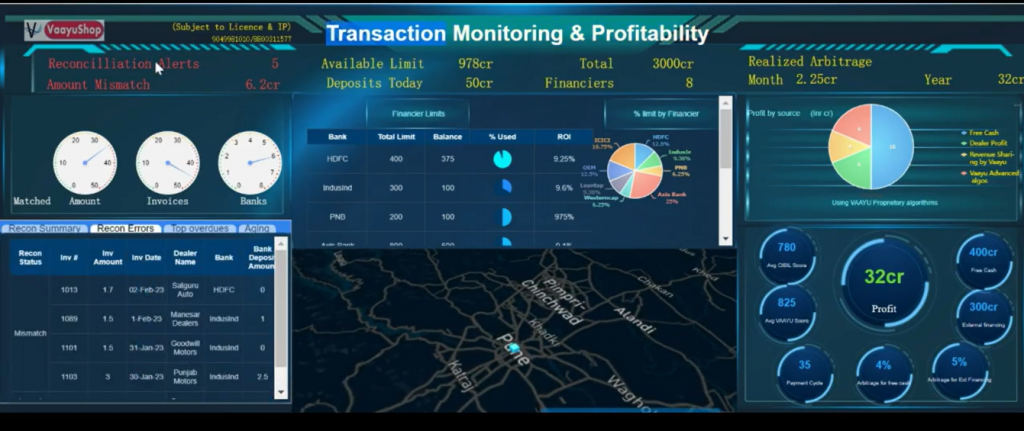
Most enterprise AI systems are still largely built around prediction, information retrieval, content generation and workflow automation.
But what if AI could also simulate what might happen when a business takes a different decision?
That is the direction we are exploring with Vaayu’s World Model.
What are we building?
Consider a bank evaluating a loan application.
A conventional model may predict the probability of default. But the actual decision involves much more.
What if the loan amount is reduced? What if the interest rate changes? How would a different repayment schedule affect customer behaviour? What would happen to the bank’s risk exposure and profitability over time?
A Financial World Model aims to understand these relationships and simulate alternative scenarios.
The same approach can apply to pricing, demand, inventory, customer conversion and capital allocation.
Our work involves temporal modelling, representation learning, predictive systems, specialised reasoning models and decision evaluation.
The objective is to move from predicting individual outcomes to understanding how business environments evolve under different decisions.
We have written more about the technical foundations in our earlier article: JEPA and World Models for Banks by Vaayu.
1. Custom-built World Models
Every enterprise has its own data, business processes and decision environment.
A general-purpose model can be a useful starting point, but it may not understand the specific dynamics of a lending portfolio, supply chain or consumer business.
We see an opportunity to build World Models around an organisation’s own data and business context.
Some examples:
- Banking and NBFCs: Credit decisions, GNPA, fraud, collections, risk-based pricing and capital allocation.
- Cleantech: Energy demand, generation, storage, consumption and asset optimisation.
- Lifestyle brands: Demand, pricing, promotions, inventory, customer behaviour and conversion.
The economic opportunity can be significant.
For a large enterprise, even a small improvement in decision quality can have a meaningful impact on profitability.
Our longer-term ambition is to identify opportunities for a potential 1–3 percentage-point improvement in EBITDA margins through better decisions. This is a hypothesis to be tested against each organisation’s baseline, data and business use cases, not a promised outcome.
2. R&D-as-a-Service and Forward Deployed Engineering
This is another area where we see a fairly immediate opportunity.
Large enterprises have already invested in data platforms, technology teams, analytics and AI infrastructure. But there are often gaps between what these systems can do and what the business actually needs.
Sometimes the missing piece is a proprietary model. Sometimes it is a new data pipeline, an evaluation framework, a specialised agent or integration with an existing system.
Building these pieces requires research and engineering together.
Our R&D-as-a-Service approach is intended to work with enterprise teams on such problems.
This could involve researching a new model architecture, training a specialised model, developing proprietary datasets or benchmarking existing models against a new approach.
Forward Deployed Engineering takes this further.
Our engineers work alongside enterprise teams to connect research with existing systems — CRM, ERP, lending platforms, data lakes and operational workflows.
The idea is to build the last pieces that help enterprises get more value from their existing technology investments.
Not every engagement needs to begin with a large deployment. It could start with one research problem or one business use case, and evolve from there.
3. Specialised Reasoning and Decision Models
There have been some interesting developments in AI recently.
OpenAI’s Decisions API and Jev are examples of a growing interest in specialised models for structured decisions, scoring and classification.
This is an important direction.
Not every business problem requires a very large model generating a detailed response. Many enterprise workflows involve millions of smaller decisions where speed, cost and reliability matter.
We are also interested in how compact reasoning models can work together.
A specialised model for credit risk, another for cash-flow analysis and another for scenario prediction can collectively support a much more complex decision.
For Vaayu, this connects directly to our World Model research. We see an opportunity to combine specialised reasoning models, enterprise data and simulation into a larger decision infrastructure.
These developments are not the same as World Models, but they reinforce the importance of specialised decision intelligence.
Exploring Design Partnerships
We have been presenting our work to multiple companies across financial services and other industries.
We are now evaluating design partners who would like to explore this approach around specific business problems.
The starting point can be one well-defined use case.
We can understand the existing systems, establish a baseline and benchmark current approaches against specialised models and Vaayu’s World Model.
Over an initial six-month engagement, the objective would be to identify where the technology can make a measurable difference and map the potential economics.
Successful experiments can then move towards deployment through Forward Deployed Engineering.
We believe design partnerships are important for deeptech development. They allow research to be tested against real business conditions, rather than only laboratory benchmarks.
What We Are Building at Vaayu
We see three connected parts to this work:
Enterprise data foundations: MDM, data lakes and model-ready enterprise data.
Intelligence: Custom World Models, specialised reasoning models and decision systems.
Research and deployment: R&D-as-a-Service and Forward Deployed Engineering.
These are not separate businesses in our thinking. They are different parts of the same problem.
Better data helps build better models. Better models help evaluate better decisions. Deployment gives us feedback from actual business outcomes.
Our presentation at Bajaj Finserv was an important opportunity to share this direction and engage with people working on innovation in financial services.
The Bajaj Finserv ecosystem, particularly its emphasis on bringing together business teams, technology, research and design thinking, makes these conversations valuable.
There is still substantial research and engineering ahead. We are looking forward to working with more organisations willing to explore these possibilities.
We believe there is an opportunity to build globally relevant deeptech AI infrastructure from India.
That is what we are working towards at Vaayu.
About Vaayu
Vaayu is building deeptech AI infrastructure for enterprise decisions, including custom World Models, specialised reasoning models, R&D-as-a-Service and Forward Deployed Engineering.
We are currently exploring design partnerships with enterprises interested in building proprietary AI capabilities around their data and business decisions.
Further reading: JEPA and World Models for Banks by Vaayu
Related discussion: Vaayu’s presentation at Bajaj Finserv