
 Posted by

OpenAI Decision API vs Jev compared to Vaayu Small World Model & Sovereign on-premises Decision Intelligence Infra
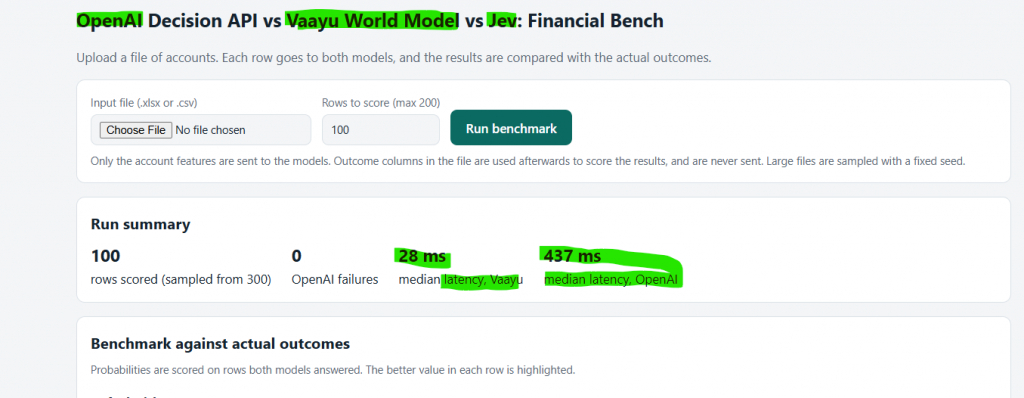
Our team is talking to many Fintechs, Banks, Infra companies on Decision Intelligence. At the same time, our time started benchmarking OpenAI Decision API, Jev vs Our own Small World Model for Decisions.
While Big Tech & AI hype builds, this post shares what the market-side reality is. Almost all players that we talk to – don’t want to lock anything right now. They want to evaluate, fit in their unit economics, and prefer key components to be owned in-house.
This post compares hardcore benchmarks of the Vaayu Small World Model for Banking Decisions against typed models Jev, OpenAI Decision API. But customised to Banking use cases.
The emerging architecture of Sovereign Decision Intelligence for Indian banks.
- Build Some, Buy Some, Lock None – A senior leader in Banking summed up the approach. It exactly matches what we hear from talks with marquee C-Suie and fintech companies
- Small is fast & low cost – Banks have constraints on Unit economics. Especially while working at scale for new-to-credit financial inclusion. C-suite recognize this.
- SOP – Sovereign, On-premises, Proprietary – Decision Intelligence infra has to be proprietary for many reasons. First, the core intelligence should remain within the enterprise. Second – enterprise needs full control of it – so if you aim to change it, you should be able to do it.
Benchmarking Vaayu Finance World Model with Typed Decision Models – OpenAI & Jev
OpenAI’s Decisions API and the emergence of Jev’s specialised decision models represent an interesting evolution in AI: moving from generative intelligence towards structured, outcome-oriented decision-making.
For financial institutions, this raises an important architectural question:
Should banks build their Decision Intelligence infrastructure around external decision models, or develop smaller, specialised Financial World Models that they can own and operate?
But how do you decide? First & foremost is benchmarking now,how your own models with newer architectures.
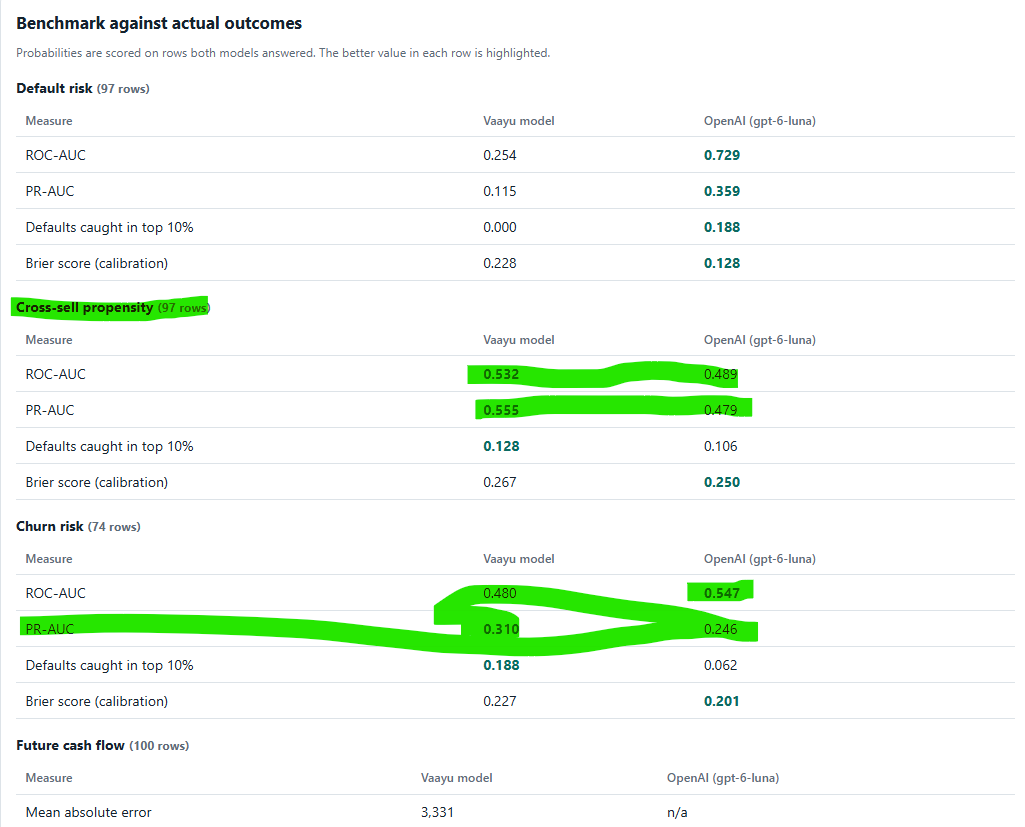
Above is a small Vaayu Financial World Model. We don’t claim it is the best yet. But it shows that a much smaller model built on premises for a bank can be quite competitive. This is built on Credit Card default data. Since, we didn’t have access to actual Master data from the bank, we created some synthetic data.
Results show that the outcomes may be promising for a proprietary model trained for banks.
- One – you can see the latency is remarkably lower. Because we deployed a co-located model. This is often used deployment in investment banking to save on latency.
- Second – Cost is much less & trained on proprietary data
- Third – Fully on-premises & full control for the bank
But the major Alpha for Decision Intelligence with World Model
But the major benefits & differentiation of architecture are this:
- This is a World Model. Which can not only give decisions; it can predict multiple outcomes of the action. Eg., how will the overall customer’s state evolve for different actions. Eg – if you offered a top-up on the existing limit – does the propensity of default increase
- Long-range & multi-dimensional reasoning – Do certain events cause 2nd-order & 3rd-order effects down the line after 3-6 months? Eg withdrawal of a subsidy can cause credit stress in certain industrial zones for Solar industries.
- Financial Modelling, not text – One of the reasons even a smaller Financial World Model is becoming competitive is that the model is trained to understand rich relationships between various dimensions of data in a financially native way. It’s different from those that are primarily text- or image-based.
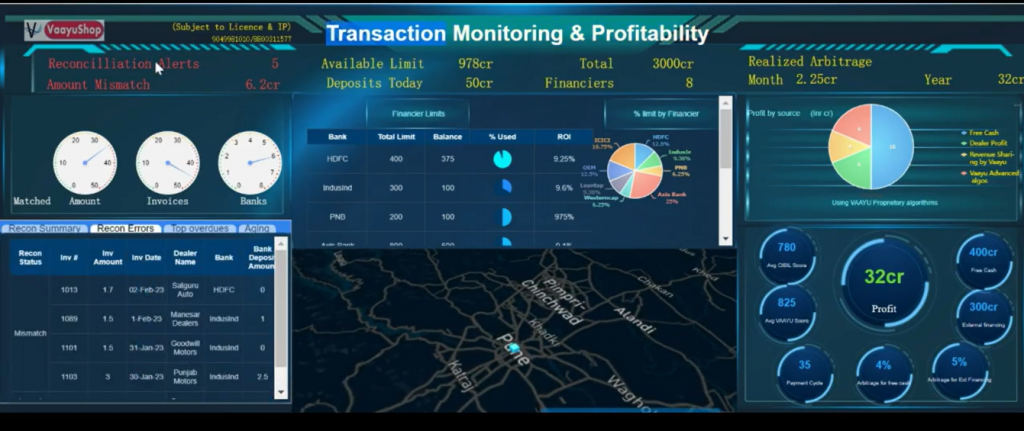
Below are some examples of end usage at the application layer of Decision Models. Which generate interesting events, triggers, arbitrages & then can be tied with autonomous actions
Why Banks aren’t locking on external Decision Intelligence
Not every financial decision requires the intelligence of a frontier-scale model. Even if a bank needs, it may be in high-stakes pockets. Eg lending for a small microfinance loan. Unit economics may not fit. Even within a product line, say credit card onboarding has different unit economics than the query by a customer.
Consider a bank processing millions of transactions, customer interactions and credit-risk assessments.
Using a large hosted model for every decision may not be the most economical architecture.
A specialised model trained for a particular financial task could potentially deliver:
- Lower inference costs.
- Reduced latency.
- On-premises deployment.
- Greater control over proprietary financial data.
- Domain-specific predictive capabilities.
- More predictable infrastructure economics.
There is also an opportunity to build a hierarchy of intelligence.
Smaller specialised models handle the majority of repetitive decisions, while larger external models are reserved for complex reasoning, exceptions and situations requiring broader contextual understanding.
This hybrid approach could offer a more sustainable architecture.
What should Sovereign Decision Intelligence infrastructure look like?
A potential architecture for Indian banks could comprise:
Financial Data Layer: Core banking, lending, payments, bureau, customer transactions and external datasets.
Financial Intelligence Layer: Entity resolution, customer intelligence, cash-flow modelling, behavioural analytics and risk features.
Model Layer: External foundation models, specialised decision models and proprietary Financial World Models.
Decision Layer: Underwriting, fraud detection, collections, credit risk, early-warning systems and scenario-based decisioning.
Governance Layer: On-premises deployment, model monitoring, auditability, explainability, access controls and regulatory compliance.
This allows banks to combine external intelligence with proprietary models without depending entirely on a single provider.
Initiatives such as RBIH’s MuleHunter.ai and the Digital Payments Intelligence Platform (DPIP) demonstrate the growing importance of intelligence-driven financial infrastructure in India.
The next opportunity is to strengthen the underlying model and decision infrastructure supporting these initiatives.
The opportunity for RBI, NPCI and India’s banking ecosystem
The emergence of Decisions APIs is an important development.
But India’s opportunity is much larger than adopting the latest external AI models.
It is to develop competitive, sovereign Decision Intelligence infrastructure that financial institutions can own, operate and continuously improve.
There is room for multiple approaches:
- Banks procuring foundational AI capabilities.
- Fintechs developing specialised financial models.
- Research institutions contributing model architectures and benchmarks.
- Financial institutions collaborating on evaluation frameworks.
- Proprietary on-premises models handling critical workloads.
At Vaayu, we believe compact Financial World Models could become an important component of this ecosystem.
Our ongoing work focuses on benchmarking specialised World Models against larger external models and conventional decisioning approaches, particularly for financial prediction, credit risk and action-conditioned decision-making.
We would be happy to contribute to RBIH and broader industry initiatives around Sovereign Decision Intelligence infrastructure through experimentation, benchmarking and collaboration with financial institutions.
Ultimately, the objective should not be to choose between OpenAI, Jev or proprietary models. It should be to ensure that Indian banks retain the freedom to use the best available intelligence while owning the infrastructure that differentiates them.
Buy Some. Build Some. Lock None.
We have written more about the technical foundations in our earlier article: JEPA and World Models for Banks by Vaayu.
1. Custom-built World Models
Every enterprise has its own data, business processes and decision environment.
A general-purpose model can be a useful starting point, but it may not understand the specific dynamics of a lending portfolio, supply chain or consumer business.
We see an opportunity to build World Models around an organisation’s own data and business context.
Some examples:
- Banking and NBFCs: Credit decisions, GNPA, fraud, collections, risk-based pricing and capital allocation.
- Cleantech: Energy demand, generation, storage, consumption and asset optimisation.
- Lifestyle brands: Demand, pricing, promotions, inventory, customer behaviour and conversion.
The economic opportunity can be significant.
For a large enterprise, even a small improvement in decision quality can have a meaningful impact on profitability.
Our longer-term ambition is to identify opportunities for a potential 1–3 percentage-point improvement in EBITDA margins through better decisions. This is a hypothesis to be tested against each organisation’s baseline, data and business use cases, not a promised outcome.
2. R&D-as-a-Service and Forward Deployed Engineering
This is another area where we see a fairly immediate opportunity.
Large enterprises have already invested in data platforms, technology teams, analytics and AI infrastructure. But there are often gaps between what these systems can do and what the business actually needs.
Sometimes the missing piece is a proprietary model. Sometimes it is a new data pipeline, an evaluation framework, a specialised agent or integration with an existing system.
Building these pieces requires research and engineering together.
Our R&D-as-a-Service approach is intended to work with enterprise teams on such problems.
This could involve researching a new model architecture, training a specialised model, developing proprietary datasets or benchmarking existing models against a new approach.
Forward Deployed Engineering takes this further.
Our engineers work alongside enterprise teams to connect research with existing systems — CRM, ERP, lending platforms, data lakes and operational workflows.
The idea is to build the last pieces that help enterprises get more value from their existing technology investments.
Not every engagement needs to begin with a large deployment. It could start with one research problem or one business use case, and evolve from there.
3. Specialised Reasoning and Decision Models
There have been some interesting developments in AI recently.
OpenAI’s Decisions API and Jev are examples of a growing interest in specialised models for structured decisions, scoring and classification.
This is an important direction.
Not every business problem requires a very large model generating a detailed response. Many enterprise workflows involve millions of smaller decisions where speed, cost and reliability matter.
We are also interested in how compact reasoning models can work together.
A specialised model for credit risk, another for cash-flow analysis and another for scenario prediction can collectively support a much more complex decision.
For Vaayu, this connects directly to our World Model research. We see an opportunity to combine specialised reasoning models, enterprise data and simulation into a larger decision infrastructure.
These developments are not the same as World Models, but they reinforce the importance of specialised decision intelligence.
Exploring Design Partnerships
We have been presenting our work to multiple companies across financial services and other industries.
We are now evaluating design partners who would like to explore this approach around specific business problems.
The starting point can be one well-defined use case.
We can understand the existing systems, establish a baseline and benchmark current approaches against specialised models and Vaayu’s World Model.
Over an initial six-month engagement, the objective would be to identify where the technology can make a measurable difference and map the potential economics.
Successful experiments can then move towards deployment through Forward Deployed Engineering.
We believe design partnerships are important for deeptech development. They allow research to be tested against real business conditions, rather than only laboratory benchmarks.
What We Are Building at Vaayu
We see three connected parts to this work:
Enterprise data foundations: MDM, data lakes and model-ready enterprise data.
Intelligence: Custom World Models, specialised reasoning models and decision systems.
Research and deployment: R&D-as-a-Service and Forward Deployed Engineering.
These are not separate businesses in our thinking. They are different parts of the same problem.
Better data helps build better models. Better models help evaluate better decisions. Deployment gives us feedback from actual business outcomes.
Our presentation at Bajaj Finserv was an important opportunity to share this direction and engage with people working on innovation in financial services.
The Bajaj Finserv ecosystem, particularly its emphasis on bringing together business teams, technology, research and design thinking, makes these conversations valuable.
There is still substantial research and engineering ahead. We are looking forward to working with more organisations willing to explore these possibilities.
We believe there is an opportunity to build globally relevant deeptech AI infrastructure from India.
That is what we are working towards at Vaayu.
About Vaayu
Vaayu is building deeptech AI infrastructure for enterprise decisions, including custom World Models, specialised reasoning models, R&D-as-a-Service and Forward Deployed Engineering.
We are currently exploring design partnerships with enterprises interested in building proprietary AI capabilities around their data and business decisions.
Further reading: JEPA and World Models for Banks by Vaayu
Related discussion: Vaayu’s presentation at Bajaj Finserv