
 Posted by
 According to the PwC Reports, the Indian market share in renewable energy is expected to increase from 4 to 15% in the next few years. We cover Top 7 Challenges for Solar EPC. It offers the Solar EPC companies a huge opportunity to double down and invest in their procurement, distribution, and networking processes. However, alongside India’s growing power generation capacity and consumer demand, certain challenges persist. Problems like monopoly restrictions, limited fuel supply, and distribution risks make it difficult for companies to actually invest in the technology and fulfil the demand.
Enters AI, a tech-driven approach that helps overcome these challenges through efficiency and innovation. But to understand the role of AI in solar industry, we must first understand what those challenges are.
This blog focuses on the current problems faced by companies that are moving forward and how AI is solving them with a fresh perspective.
What Are the Challenges Faced by Solar Companies?
Daan Struyven at Goldman Sachs explains how solar generation is growing the fastest in the history of electricity. In fact, the global solar installations are expected to rise 57% by 2030.
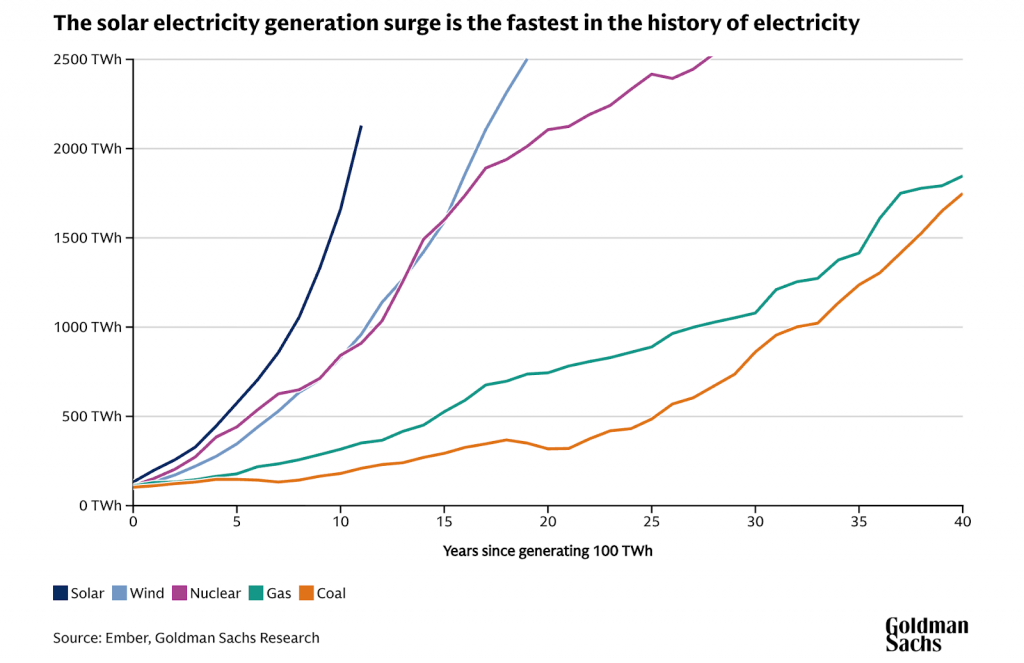
But with the rapid development in the solar industry, a mismatch between expectations and reality can affect how EPC companies operate. Here are some of the challenges that are affecting the adoption and performance on a large scale:
- Inaccurate Site Assessment
Proper assessment of the solar panel installation site is important to make sure nothing goes wrong in the long run. But when developers do not consider structural integrity, poor weather conditions, and shading problems, they end up choosing the wrong location. These roadblocks can result in grid imbalances and low dependability.
- Lack of Skilled Technicians
If solar companies cannot identity the right technicians for the job, they risk affecting the installation process. It leads to significant delays in the project, limited expansion possibility, and loss of deals.
- Poor Solar Panel Training
Integrating a solar panel with an existing power grid is complicated and demands proper training before execution. Companies risk power failure, damage, and costly repairs in the long run if they don’t focus on training technicians.
- Supply Chain Mismanagement
Solar EPC companies are directly dependent on suppliers for raw materials, and if there is even a slight disruption in this supply chain, it delays the projects. In fact, consistent mismanagement of raw material procurement can eventually lead to lost projects and increased losses.
- Ineffective Monitoring
Even after successfully installing a solar panel, the job isn’t over. Companies need a dedicated team to continuously monitor the performance and make sure that there is no interruption. Problems like wiring fault, dust collection, and grime deposit can affect how the systems generate electricity.
- Financial Risk
The idea is noble, but setting up a solar industry can be costly. Without backing and investor funds needed for research and development, companies risk cash flow maintenance. Additionally, some companies charge high import tariffs on raw materials, adding to the investment cost quickly.
- Frequent Downtime
One of the common issues solar companies face is a poor electrical connection. Any connectivity problem directly leads to downtime, cutting off the electricity in the area. If the warning signs are not detected early, such interruptions become a common concern and are costly to address.
Site assessment, training, monitoring, and early warning sign detection – everything is possible if solar companies introduce AI to their engineering coworkers.
What is the Impact of AI on the Solar Sector?

The solar AI market is continuously growing and aims to reach 280 GW capacity by 2030.
Power suppliers can adopt an AI-driven approach to meet the rising demand for solar electricity in India. Here is how it is changing the way the EPC companies operate today:
- Site Selection
Manually choosing the site for grid installation can lead to shading, wiring, and climatic issues. AI uses satellite imagery and terrain analytics to study hundreds of sites at once. It helps companies shortlist the most appropriate location and replaces guesswork with precision.
- Predictive Maintenance
An AI coworker continuously studies the functioning of solar panels and their components, like inverters, panels, and wires. By comparing the previous and current data, it detects early failure signs, like voltage or temperature fluctuations and wear or tear. As a result, technicians can check and repair the panel components timely to prevent expensive repair work.
- Automated Visual Inspection
It is tough to inspect multiple solar panels on a large site and detect tiny cracks, dirt accumulation, or wiring faults. Such problems can slowly result in safety complications. With the help of AI, you can detect the smallest of problems and fix them on time. It works because your coworker can scale the team without heavy hiring. Fewer but smarter resources, that’s the goal.
- Energy Optimisation
AI-enabled devices can analyse huge chunks of data in a short time. Whether you want to know about grid constraints, weather forecasts, or forthcoming energy prices, they act as your support system to make sure energy isn’t wasted. It customises the battery charging/changing schedules, energy consumption patterns, and tilt adjustments to make sure the energy is utilised in the best way possible.
- Cost Saving
AI-powered systems predict small issues before they turn into a costly repair or prolonged downtime. As a result, your utility bills reduce, and there’s minimal energy wastage. The cost savings increase over time.
Conclusion
AI and the solar industry work cohesively to bridge the gap between the supply and demand of electricity in India. When AI works as your coworker to control costs, monitor performance, and diagnose issues early, your company can contribute to the transition toward a greener and more sustainable future.
As India’s solar industry expands, AI-driven solutions help make sure that you can optimise your supply chain, assess sites properly, and predict upcoming issues to reduce downtime. Today, companies like Vaayu Shop are automating the workflow to increase efficiency and streamline operations.