
 Posted by
 Introduction
Solar industry in India is increasing at a CAGR of 13.4%. It is also expected to reach USD 24.9 Billion by 2030. The major reasons for it are government incentives, increasing energy costs, and growing demand from residential and commercial customers. However, the inability to scale and handle large volumes of queries restricts the growth of solar businesses.
For any company, dealing with coordinating with dealer networks and tackling sales complexities requires heavy, qualified hiring. This problem especially increases when you try expanding to tier 2 and tier 3 markets. That’s when AI co-workers act as your support system and simplify the operations.
Capable AI assistants help manage lead volumes, speed up sales systems, and handle multiple distribution channels. As a result, your company can grow without increasing the headcount.
Indian Solar Market Size and Growth Trends
Solar industry in India has expanded rapidly recently, driven by strong government support and the growing presence of key players such as Adani, ABB, GCL, and JA Solar.
- Moreover, the Ministry of New and Renewable Energy aims to generate 500 GW of non-fossil electricity by 2030. This solar energy adoption is one of the reasons why the solar energy adoption rate is quickly increasing in the country.
- The government has introduced several schemes like the Defense Scheme, Grid Connected Solar Rooftop Scheme, Bundling Scheme, and CPSU scheme to support solar power generation.
- These schemes are speeding up the solar ecosystem development process by offering innovation, expertise, and funding.
- The government is also offering tax benefits to solar companies so their setup expenses are reduced.
If the practices sustain, the average power supply cost is anticipated to drop to INR 5.4 per kWh by 2050 due to the transition from thermal to solar power.
What is Driving Solar Adoption in India?
India’s clean energy journey focuses on its commitment to sustainability. A fine example is Diu, a small union territory that once struggled with power connection. Today, its daytime energy needs are met through solar panels. Here is why the solar industry in India is quickly accelerating:
- Rising Electricity Cost
Power prices are continuously increasing for both businesses and households, pushing them to look for cost-effective solutions. Solar energy acts as a renewable source, reducing cost and acting as a practical investment.
- Government Policies
Initiatives like rooftop installation subsidies and solar parks have contributed to India’s transition to solar energy. Government initiatives like the PM Surya Ghar scheme, subsidies, and net metering policies have further accelerated the adoption across all sectors.
- Growth in Tier 2 and Tier 3 Cities
Since the government has improved the financing options and local distribution channels in tier 2 and tier 3 cities, they have also been able to adopt the solar movement. These emerging markets are becoming key growth drivers for solar companies.
- Sustainable Initiatives
Companies are continuously working to align themselves with sustainability goals. Amid the concern of depleting energy resources, solar energy comes out as a winner. It improves perception in front of customers and reduces the carbon footprint, fulfilling two goals at once.
- Easy Accessibility
Solar loans and EMIs are available today, offering flexible payment solutions to customers. This practice eliminates the entry barrier and allows households and businesses to adopt solar solutions.
The growing demand for solar energy is motivating companies to work harder, fetch more leads, and deliver the service. However, converting the leads into revenue still remains a challenge, especially if companies don’t want to heavily invest in hiring.
What Are the Key Challenges in Scaling Solar Sales and Distribution?
Operational challenges increase when companies plan to expand across regions and reach different customer segments
Some of the problems that solar service providers have to regularly face are:
- Handling Lead Volume
Solar power companies receive enquiries from different channels. It could be from websites, WhatsApp groups, and dealer networks. But without increasing the manpower, handling them becomes tough. It ultimately results in missed opportunities and delayed sales cycles.
- Poor Lead Conversion
Every lead doesn’t have to be intent-based, as many approaches are low-quality. If sales teams do not verify these leads and waste time on such prospects, the conversion rates drop and CAC (customer acquisition cost) increases.
- Fragmented Distribution Channels
Many times, solar energy companies depend on different dealers, distributors, and third-party installation partners. Due to lack of a centralised coordination network, it becomes difficult to maintain consistent pricing and service timelines.
- High Operational Dependency
Many processes, including lead management, follow-ups, coordination, and documentation, are handled manually. This increases dependency on human effort and makes scaling difficult without increasing team size. AI coworkers as your support system can take up the repetitive tasks, scan datasets for qualified leads, and speed up the delivery process.
How Do AI Co-workers Drive Lead to Revenue Growth?
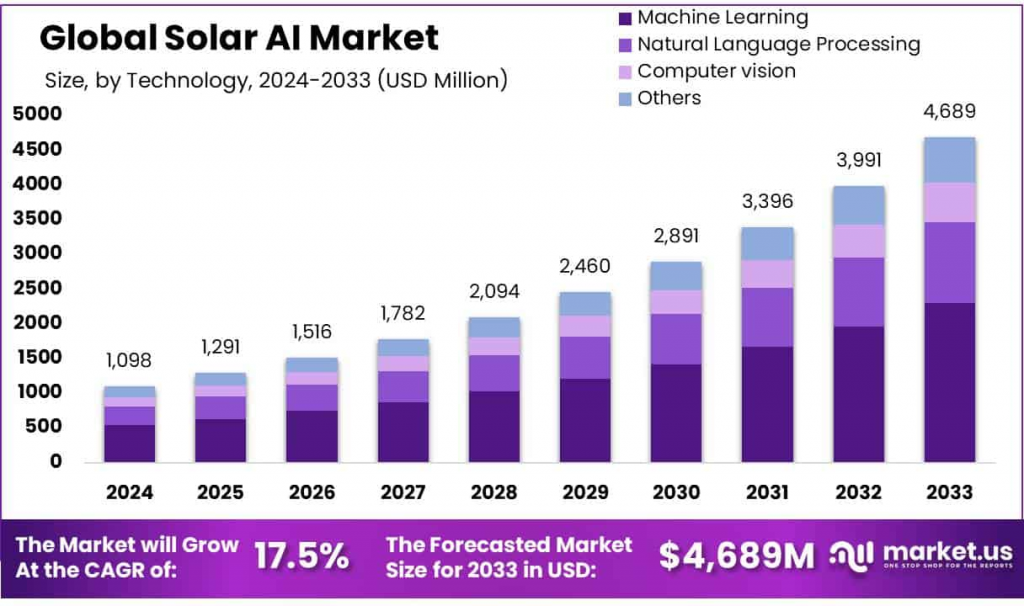
The global solar AI market is expected to continuously grow with a CAGR of 17.5%.
As solar demand increases, the focus of businesses shifts from generating quality leads to converting them into revenue. Their goal is to respond early, focus on important queries, and shorten the sales cycle.
AI integration can help teams increase their operations without heavy hiring.
- Lead Generation and Qualification
Your AI assistant can identify the right leads from different sources to save time. It then analyses those leads to divide them into high- and low-intent prospects so the sales team can focus on the former.
- Response and Follow-Up
Slow coordination between sales and prospective customers leads to lost opportunities. That’s why AI co-workers communicate with the potential clients, follow up, and make sure there are no delays from the sales team’s end.
- Conversion Rates
When AI specialists prioritise high-intent leads and follow through on them, conversion rates improve. Sales team can focus on decision-making instead of continuous tracking and communication.
- Distribution and Dealer Coordination
An AI coworker manages conversations between central teams and dealer networks to avoid delays and ensure better reach across regions.
- Operational Efficiency
An AI assistant can manage monotonous tasks like document handling, data entry, and status tracking. It helps reduce workload so teams can focus on strategic tasks and boost workplace productivity.
Conclusion: Human + AI for Pan-India Solar Expansion
The solar industry in India is continuously growing due to increasing demand, government support, and a rapid adoption rate. But business expansion also comes with new challenges when scaling. Sole dependency on human expertise can only take you so far. Ultimately, the excess workload or costly hiring slows order fulfilment or diminishes your profit margins.
That’s why companies are using artificial intelligence to meet demands, improve lead management, and speed up decision-making. The balance of human and AI expertise helps solar businesses scale without increasing cost.