
 Posted by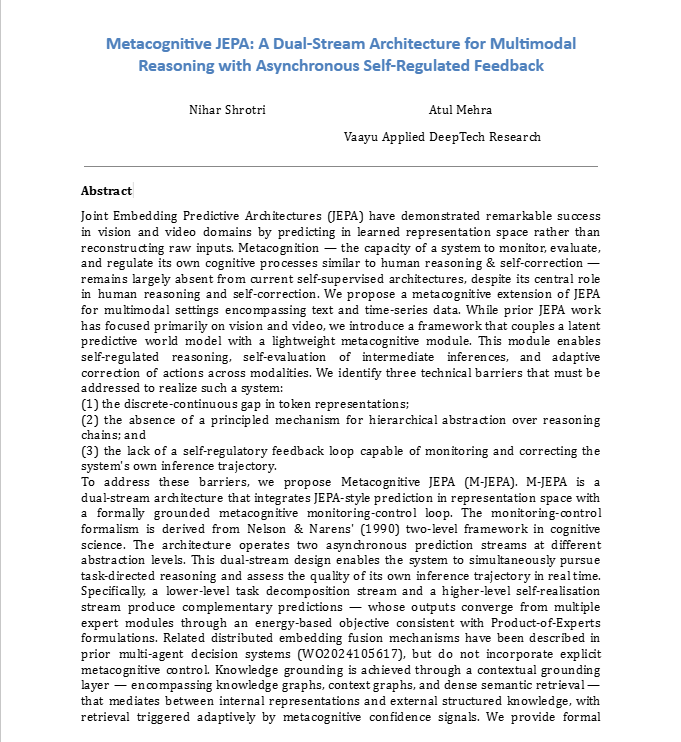
Introduction
This is a simplified version of the Technical Research paper – Small Reasoning Model based on JEPA, World-models with Self-Regulation. This is about Advanced AI Architectures. Wording & content have been softened for business & functional readers.
For real-world use cases & even simpler applications, visit our blog.
You may reach out to us for collaborations, if you are a PhD, a US-based consulting firm or Investor Or University/Corporate setting up AI practice.
Decision Intelligence, Objective-driven systems, Limitations of LLMs
A truly autonomous and efficient enterprise system must reason, plan, and act under real-world constraints with changing context & dynamics. This includes latent states or 2nd or 3rd order effects.
For example, an aggressive marketing push may increase customer acquisition, but also raise service load, impact brand perception, and eventually influence financial outcomes.
Multi-Stage Control System
Multi-stage Control vs LLMs Multi-stage reasoning

The above equation depicts the mathematical formulation whereby the model minimizes the cost of a sequence of actions, taken under constraints. Thus maximizing the outcome. On the other hand LLMs mathematical formulation is basically to predict the next token.
Limitations of LLMs & Road to Small Reasoning models
LLMs lack natively built reasoning
Though LLMs can mimic reasoning like behavior, that’s not what LLMs are natively trained on.
LLMs, basically, at the core of it are next token predictors, not the reasoning, planning systems.
Lack of world & environmental/world modelling
In view of new information & data, the biggest limitations come that LLMs need to be distilled, fine-tuned or multiple expert agents be orchestrated for multi-dimensional reasoning & planning in a dynamic environment. Though RAG can make pipelines look dynamic, they may start hallucinating.
Self-critical or regulation is missing
The biological brain, even in animals, can update their world models based on past experiences & learnings pretty quickly. This comes as self critique view of one’s own action & updating the world model inside our brains.
LLMs or today’s reasoning models lack this.
Constraint dynamics are missing
LLMs don’t factor in changing constraints with desired quality. As we said, RAG & external systems may improve it, but they don’t update the world model.
Putting it all together
Take the same example.
Aggressive Marketing Push -> Increased Customer Acquisitions -> Increased service load -> Impacts brand Perception -> Impact financial outcomes
This sort of Decision system run by humans would need, e.g., a board meeting.
Planning & executing like board to ops
Board Review meeting(3 Months) -> C-suite reviews (Separate streams – Every week; Cross Functional impact(Latent States) is synced up say once a month) -> Operational Teams (Every week)
Creating above Autonomous AI Agent systems with assembling workflows suffers from serious drawbacks.
Vaayu is building Decision to ops loops & enterprise Decision Intelligence that sets goals like a boardroom, plans like C-suite & executes like Ops for Cleantech & mid-market.
Decision Intelligence system & current technical paper
This paper focuses on specific gradients.
- Multimodality with JEPA – Enterprise AI systems need Multimodality with text & Data Series. Combined with JEPA this makes a strong paradigm for Autonomous systems for Decision Intelligence.
- Hierarchical abstraction over reasoning chains
- Metacognition – A self-regulatory feedback loop capable of monitoring and correcting the system’s own inference trajectory.
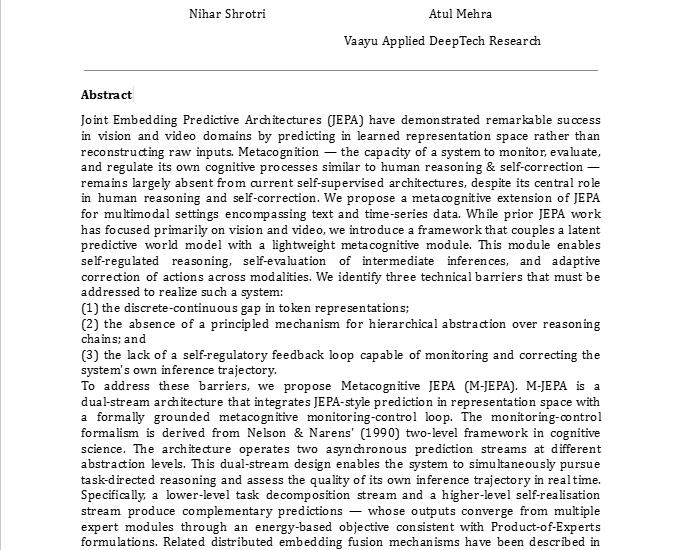
Abstract
Below is a simplified version of the technical paper for business or functional readers users
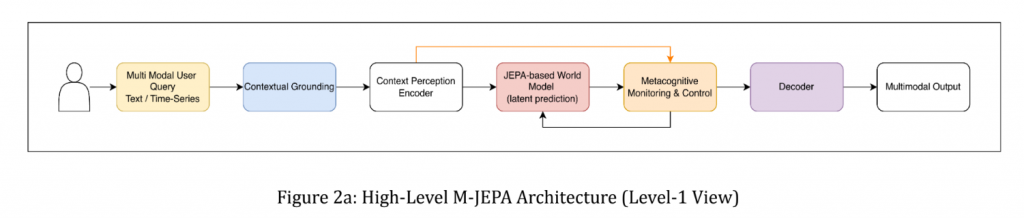
MJepa – World model, Latent States, MetaCognition & JEPA architecture
JEPA (Joint Embedding Predictive Architecture) represents a shift from traditional LLMs.
While LLMs predict the next token, JEPA-style models aim to predict future latent representations of the world. This allows models to reason about underlying states and second-order effects, not just language patterns.
Enterprise Decision Intelligence based on latent states with self-regulating loops
For example, an aggressive marketing push may increase customer acquisition, but also raise service load, impact brand perception, and eventually influence financial outcomes.
Such multi-step, system-level dynamics are closer to what JEPA-like architectures aim to model.
Meta-cognition allows the Enterprise AI stack to self-learn & reason from past decisions. Advanced Enterprise AI stacks will increasingly have these features in some form or another.
Vaayu Applied Deeptech AI Research
Vaayu Applied Deeptech AI Research is advancing – AI Reasoning, Multi-stage Decisioning & planning by predicting world states with small reasoning models based on multiple sub-world models in the Enterprise context. Eg a Small Reasoning model for Cleantech companies.
These foundations enable Decision Intelligence that goes beyond static pattern recognition offered by LLMs—helping enterprises simulate outcomes, optimize decisions over time, and execute reliably in dynamic operating environments.
JEPA & Distributed Decision Intelligence
The Joint Embedding Predictive Architecture (JEPA) paradigm, introduced by LeCun (2022) is essential to Machine & Decision intelligence. Future architecture is capable of Reasoning, Planning & predicting future latent states.
Alternative ways to implement Decision Intelligence
In previous versions of Vaayu AI Research systems, we introduced a Distributed Decision Intelligence system, with a focus on multi-dimensional decision-making with Distributed AI systems. It was narrowly focused on agent orchestration & decision making for optimizing profit.
This was aimed at replacing the intuition-based decision-making.
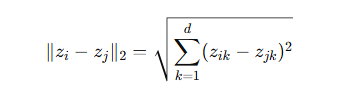
It was based on a different architecture than JEPA. It worked with minimizing the Euclidean Distance between multi modal vector embeddings.
Putting it all together – Vaayu Digital Workers with Decision Intelligence for Cleantech
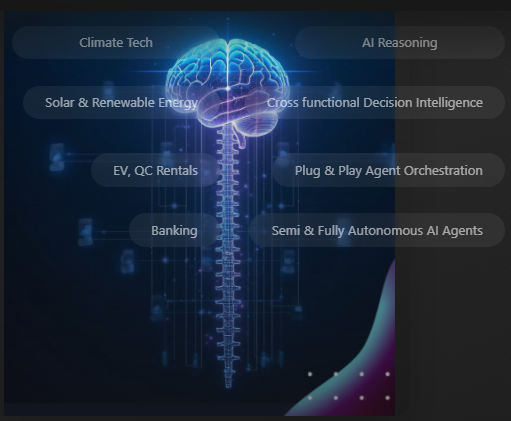
Vaayu’s focus has always been on a deep proprietary stack.
Our unique Engineering-Led-Applied-Deeptech-AI approach
Catching the gradients in the market
There are several knobs in Applied AI Research that, when turned right, can make Vaayu the category winner in Cleantech.
While Vaayu’s core Enterprise Platform focuses on GTM & revenue-engine for the company, Vaayu AI research works on the innovation gradients. One of which can give us exponential growth.
Vaayu AI Research works on futuristic technologies in AI Reasoning, Planning, and cross-functional Intelligence. Eg. take a rather applied AI research approach, which is directed to solve specific problems in Cleantech & the problems we solve.
Rather than frontier AI Research, our work, like this, is less capital intensive ($2-4M investments), is deployable within 6 months to 1 year once GPU, Data & the resources are in place. This includes GTM.
What next?
We are selectively raising from deeptech/enterprise AI funds and strategic corporates (Cleantech, manufacturing, Salesforce/Zoho ecosystem).
Additionally, if you are a PhD student or a Doctorate in AI or Management, reach for applied research.
If you prefer more business-oriented reading, read Anthropic-OpenAI-led ITpcolyses: Opportunities & threats to IT
If you prefer a more technical style & depth – pls request here. Please feel free to cite, adapt, build, remix based on the open Research license. Mehra, A., & Nihar Shrotri (2026).
Metacognitive JEPA: A Dual-Stream Architecture for Multimodal Reasoning with Asynchronous Self-Regulated Feedback
Vaayu AI Technical Report.
Read more – Vaayu’s past work & journey towards AI Reasoning & Autonomous systems