
 Posted by
A few years from now, many leaders may look back at this period as a pivot point in their careers.
The question will not simply be whether you knew how to use AI. It will be whether you turned AI into measurable business results. For senior managers balancing strategy with execution, that distinction matters.
This makes AI for Middle Managers less about experimenting with software and more about stepping up. That could mean redesigning a sales workflow, automating trade show lead capture, or introducing an AI Co-worker to a team.
Technology shifts tend to favor people who apply new capabilities early rather than waiting for perfect conditions.
AI Co-workers Are Creating a New Test for Managers
Many companies have moved beyond asking whether AI matters. The harder challenge is making it work across real business processes.
McKinsey’s research shows plenty of companies use AI, but almost two-thirds still struggle to scale it. As a result, only 39% of businesses are actually seeing a real impact on their bottom line.
This is where middle managers become important.
Senior executives can announce an AI strategy, while employees can experiment with tools. But managers often have to connect AI with actual work.
Imagine an AVP of Sales who notices that leads collected at exhibitions remain in spreadsheets for days. Instead of simply buying another tool, the manager redesigns the process:
Trade show → visiting card capture → CRM entry → lead qualification → AI follow-up → salesperson alert.
That manager is no longer simply supervising a team. They are improving how the business operates.
That is the practical side of AI transformation leadership: identifying a problem, changing the workflow, measuring results, and helping people adopt the new process.
How Middle Managers Can Use AI to Get Promoted
Managers who continuously create that narrative become indispensable.
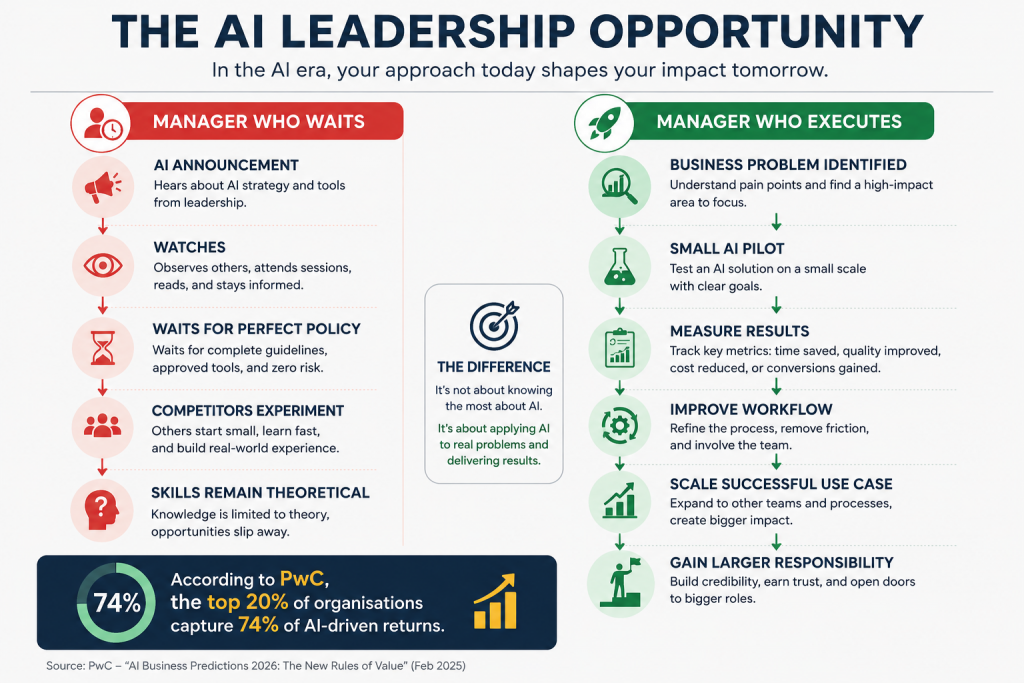
Take two leaders with the same bottleneck, such as leads lost to slow follow-up. The first plays it safe, waits for corporate to issue an AI policy, approve software and mandate training. The second runs a targeted AI trial, with human checks in place, speeds up responses, and shows real business impact. That second manager isn’t just using tech; they are building real AI leadership skills.
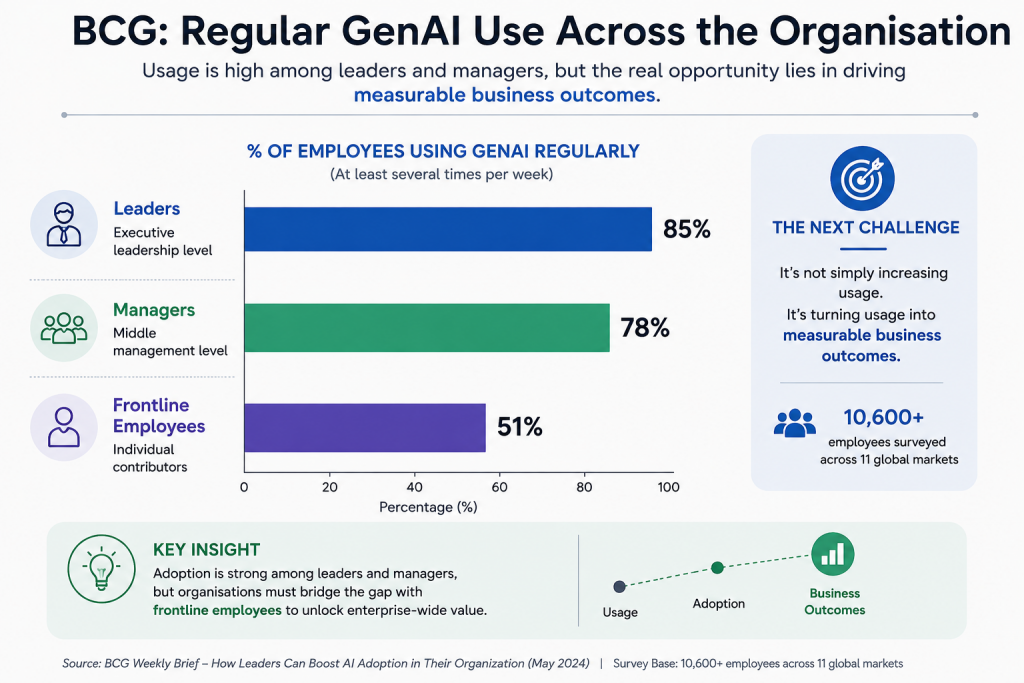
BCG research shows that 78% of managers use generative AI several times a week, compared with 51% of frontline employees. The end game, the growth path, is closing this adoption gap. The managers that can get teams to move from experimentation to practical adoption become the key strategic partners that senior leadership turns to.
What Banking Computerization Can Teach Today’s Managers
AI is not the first technology shift to change management.
When banks moved from manual, paper-heavy operations to computerized systems, technology affected record-keeping, transaction processing, reporting, customer service, and operations at scale.
Some managers viewed computerization as an IT problem. Others saw it as a change in operations.
The second group had to answer practical questions such as:
- What processes to change first?
- How to train employees?
- What manual steps could be eliminated?
- How would customers respond?
- How could technology improve speed and accuracy?
The lesson for today’s managers is simple: technology adoption creates leadership opportunities when someone takes responsibility for implementation.
AI is having a similar moment. A manager doesn’t have to become a machine-learning engineer. They need enough understanding to spot useful problems, redesign workflows, manage risks and help employees use AI responsibly.
That is why AI for Middle Managers is a leadership issue, not simply an IT trend.
The Internet Era Had the Same Pattern
The early internet created another divide.
Some business leaders saw it as an addition to traditional operations. Others asked bigger questions:
- Can customers look us up online?
- Can we sell it as is?
- Are digital channels frictionless?
- Can Internet data help in decision making ?
- What if competitors develop these capabilities first?
The winners were not always the ones who called it all correctly. Often they were the leaders who were willing to experiment and learn.
AI presents the same opportunity. Managers do not need to predict exactly what AI will look like in five years. They need to identify where it can create value today.
PwC’s 2026 AI Performance Study found that the top 20% of organizations captured 74% of AI-driven returns. These leading companies were also twice as likely to redesign workflows around AI rather than simply add AI tools to existing processes.
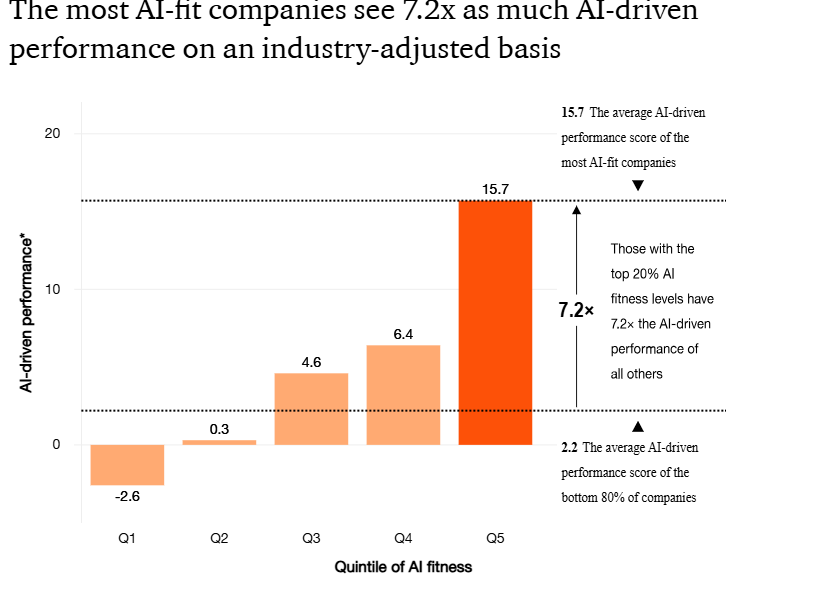
That matters because workflow redesign is often where middle managers can have the greatest influence.
AI Co-worker: Start With One Business Problem
The easiest mistake is trying to implement AI everywhere.
A better approach is to begin with one measurable problem.
AI for Lead Follow-Up
A sales team may generate hundreds of enquiries through LinkedIn, WhatsApp, website forms, campaigns, and referrals. The challenge is not always lead generation; it can be the delay between receiving a lead and following up.
An AI Co-Worker can help foster conversations, help with timely follow-ups and keep lead info, all while salespeople focus on qualified conversations.
AI for Trade Show Lead Capture
Trade shows create another opportunity for managers to demonstrate execution.
Gathering 500 business cards is not the same as having 500 usable leads. A manager can restructure the workflow after the event so contacts are captured, organized, prioritized and followed up while the event is still fresh in the mind of the attendee.
These are practical examples of AI transformation leadership. The manager is not simply introducing AI; they are solving a workflow problem.
The AI Leadership Opportunity
The AI era is creating a clear divide between leaders who wait and those who act. While some managers watch from the sidelines, others identify real business problems, test AI in small ways, measure the results, and build on what works. The difference is not simply knowing more about AI, it is turning that knowledge into action, learning from the results, and creating a stronger path toward greater responsibility and leadership.
The AI Leadership Skills That Matter More Than Prompting
Knowing how to write a good prompt is useful, but it is not enough for senior leadership.
The most valuable AI leadership skills include:
- Problem selection: Knowing which business issue is worth solving.
- Workflow design: Understanding how AI and people should work together.
- Measurement: Defining success before launching a project.
- Change management: Helping employees understand how their work will change.
- Judgment and governance: Knowing where human approval, privacy controls, and oversight are necessary.
Middle managers bridge the gap between strategy and reality, they know the operational grit, but still have the authority to change how work actually happens.
AI Adoption Does Not Equal AI Value
The next challenge is not simply increasing usage. It is turning usage into measurable business outcomes. BCG’s survey covered more than 10,600 employees across 11 markets.
The Risk of Waiting Too Long
Smart caution around AI makes sense, but waiting for total certainty holds you back. While you delay over-analyzing every risk, proactive peers are gaining the hands-on experience you are missing.
Those colleagues may be able to say:
- “I led our first AI sales workflow.”
- “I reduced manual lead processing.”
- “I introduced AI-assisted follow-ups.”
- “I trained a team to work with an AI Co-worker.”
- “I identified where human review was necessary.”
- “I scaled a successful pilot across multiple regions.”
That experience can directly support AI career growth for managers.
Conclusion: The Middle Manager’s Choice
Just as PCs and the internet reshaped work, AI is driving the next management shift.
AI for Middle Managers isn’t top-level hype, it’s about tackling daily operational headaches and delivering real results. Fix trade show lead capture, speed up follow-ups, or test an AI Co-Worker on a single workflow.
With Vaayushop, deploying these tools to streamline operations and drive revenue is seamless. When promotion time comes, the leader who proved AI works will stand out.